Laptop + shopping cart = mobile
This guy can roll up with laptop and webcam to record robots (photo CC from violetblue):
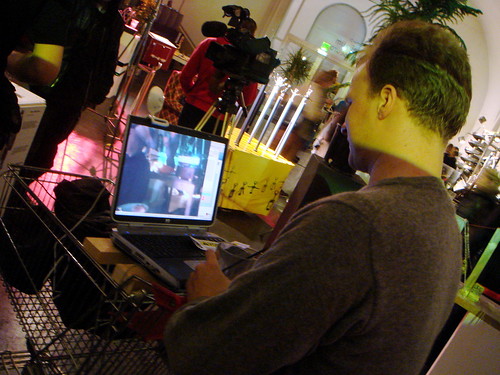
But in Silicon Valley, combining laptops and shopping carts is just a way to get chores done. When at Whole Foods in Los Altos, I saw a man pushing a shopping cart with a laptop in the part where you can sit your toddler. I suppose he was reading a recipe or something. (I, and I’m sure other Valley folks, do that on a phone.)
A bit odd, but then again, I used to be (I’ve fallen off a bit) judicious about capturing the contents of my shopping cart with ZoneTag.

Texting 4 Health conference in review
As I blogged already, I attended and spoke at the first Texting 4 Health conference at Stanford University last week. You can see my presentation slides at SlideShare here, and the program, with links to the slides for most speakers is here.
The conference was very interesting, and there was quite the mix of participants — both speakers and others. There were medical school faculty, business people, people from NGOs and foundations, technologists, representatives of government agencies and centers, futurists, and social scientists. Everyone had something to learn — I know I did. This also made it somewhat difficult as a speaker because it is hard to know how best to reach, inform, and hold the interest of such a diverse audience: what is common ground with some is entirely new territory with others.
I think my favorite session was “Changing Health Behavior via SMS”. The methods used by the panelists to evaluate their interventions were both interesting to reflect on and good tools for persuading me of the importance and effectiveness of their work. One of my reflections was about what factors to vary in doing experiments on health interventions: there is (reasonable) focus on having a no-SMS control condition, and there are very few studies with manipulations of dimensions more fine-grained. Of course, the field is young and I understand how important true controls are in medical domains, but I think that real progress in understanding mobile messaging and designing effective interventions will require looking at more subtle and theoretically valuable manipulations.
You can see other posts about the conference here and here. And the conference Web site is also starting a blog to watch in the future.
Definitions of unconscious processing in cognitive and social psychology
John Bargh, Professor of Psychology at Yale, and his ACME (Automaticity in Cognition, Motivation, and Emotion) Lab are doing very exciting work. I had read some articles by Bargh some time ago (e.g. Bargh & McKenna 2004) and encountered his work in the context of debates about how objects can automatically activate attitudes that apply to them. But it hasn’t been until recently (following a discussion with James Breckenridge) that I’ve begun to really engage with the larger body of research Bargh and his collaborators have produced — and the interesting reflections and arguments found in the reviews of this and related work that he and his collaborators have written.
I expect I’ll be writing more about this work, but in this and some follow-up posts I want to just say a little bit about the general character of the research and, more specifically, how this work engages with and employs definitions of ‘unconscious’ and ‘unconscious processing‘.
Bargh & Morsella (2008, in press, page numbers are to this version) highlights how cognitive psychology and social psychology have operated with different definitions and different emphasis in investigating what they call “unconscious”. For cognitive psychology, “subliminal information processing – […] extracting meaning from stimuli of which one is not consciously aware” – has been paradigmatic of the unconscious (p. 1). That is, its study of unconscious processing is the study of the processing of stimuli of which one is unaware. On the other hand, for mainstream social psychology research, including work with priming, “the traditional focus has been on mental processes of which the individual is unaware, not on stimuli of which one is unaware” (Ibid.).
This is a striking difference that, as Bargh & Morsella illustrate, has consequences for how “dumb” or “smart” and “limited” or “pervasive” unconscious processing is. If unconscious processing is limited to processing of subliminal stimuli, then it doesn’t have much to go on. But the social psychology definition — the liberal, process-awareness definition — allows us to call a lot more things unconscious processing.
I recognize shortcomings with the cognitive psychology definition — the narrow, stimulus-awareness definition. And Bargh and Morsella’s statement of the process-awareness definition does enable them to say some striking things (e.g. about automatic activation of motivations).
But I also wonder whether this redefined term can bear much theoretical weight. Specifically, I have two concerns:
- this definition makes what is unconscious depend on each person’s knowledge of the causes of their actions — and this can get tricky in unintuitive and highly individual ways
- this definition seems to count on having good identity conditions for the kinds of objects to which ‘unconscious’ is supposed to apply (e.g. events, processes), but identity conditions (which are often hard to come by in general) are tricky for this domain in particular.
These are familiar problems in philosophy of mind, and they deserve consideration when designing theoretically useful definitions of unconscious processing. I aim to take up each of these issues in more detail in another post.
Bargh, J.A., & McKenna, K.Y.A. (2004). The Internet and social life. Annual review of psychology, 55, 573-590.